|
It is our duty to future generations, through the cautious largesse of our antecedents, to care for the land to the best of our ability.͏ ͏ ͏ ͏ ͏ ͏ ͏ ͏ ͏ ͏ ͏ ͏ ͏ ͏ ͏ ͏ ͏ ͏ ͏ ͏ ͏ ͏ ͏ ͏ ͏ ͏ ͏ ͏ ͏ ͏ ͏ ͏ ͏ ͏ ͏ ͏ ͏ ͏ ͏ ͏ ͏ ͏ ͏ ͏ ͏ ͏ ͏ ͏ ͏ ͏ ͏ ͏ ͏ ͏ ͏ ͏ ͏ ͏ ͏ ͏ ͏ ͏ ͏ ͏ ͏ ͏ ͏ ͏ ͏ ͏ ͏ ͏ ͏ ͏ ͏ ͏ ͏ ͏ ͏ ͏ ͏ ͏ ͏ ͏ ͏ ͏ ͏ ͏ ͏ ͏ ͏ ͏ ͏ ͏ ͏ ͏ ͏ ͏ ͏ ͏ ͏ ͏ ͏ ͏ ͏ ͏ ͏ ͏ ͏ ͏ ͏ ͏ ͏ ͏ ͏ ͏ ͏ ͏ ͏ ͏ ͏ ͏ ͏ ͏ ͏ ͏ ͏ ͏ ͏ ͏ ͏ ͏ ͏ ͏ ͏ ͏ ͏ ͏ ͏ ͏ ͏ ͏ ͏ ͏ ͏ ͏ ͏ ͏ ͏ ͏ ͏ ͏ ͏ ͏ ͏ ͏ ͏ ͏ ͏ ͏ ͏ ͏ ͏ ͏ ͏ ͏ ͏ ͏ ͏ ͏ ͏ ͏ ͏ ͏ ͏ ͏ ͏ ͏ ͏ ͏ ͏ ͏ ͏ ͏ ͏ ͏ ͏ ͏ ͏ ͏ ͏ ͏ ͏ ͏ ͏ ͏ ͏ ͏ ͏ ͏ ͏ ͏ ͏ ͏ ͏ ͏ ͏ ͏ ͏ ͏ ͏ ͏ ͏ ͏ ͏ ͏ ͏ ͏ ͏ ͏ ͏ ͏ ͏ ͏ ͏ ͏ ͏ ͏ ͏ ͏ ͏ ͏ ͏ ͏ ͏ ͏ ͏ ͏ ͏ ͏ ͏ ͏ ͏ ͏ ͏ ͏ ͏ ͏ ͏ ͏ ͏ ͏ ͏ ͏ ͏
|
|
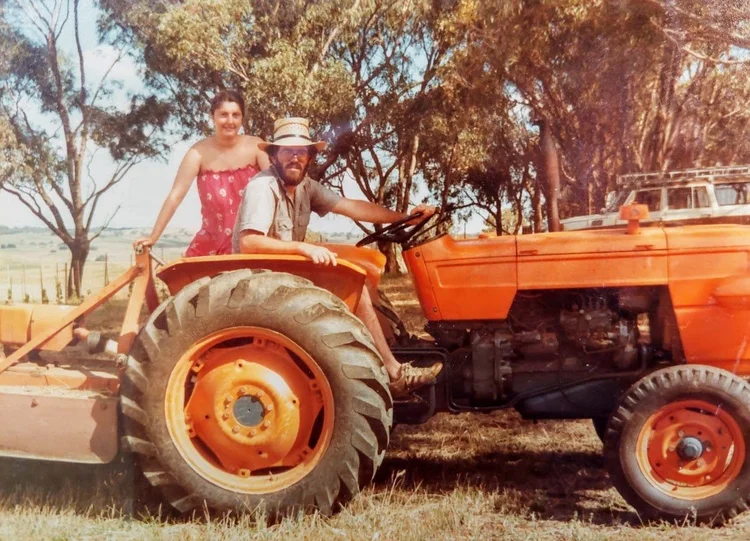
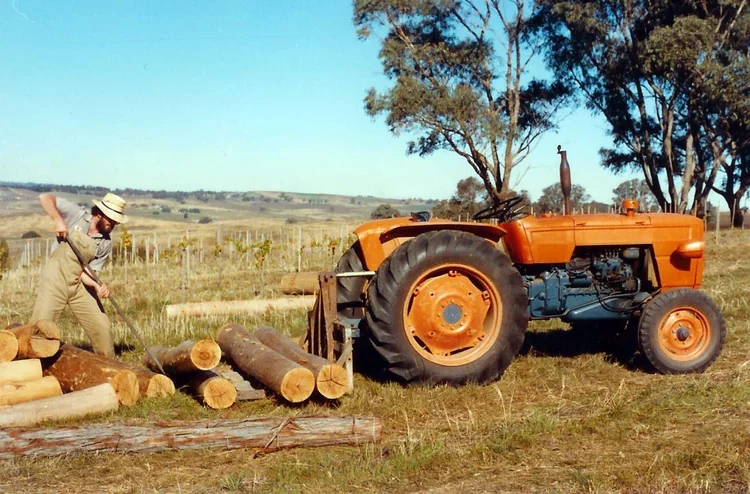
The Fiat (Fix It Again Tony) Accompli rides again! Who are those young people? As our favourite philosopher Randy Newman says..”Everybody goes bad eventually” |
|
Respecting the pastNo one on the land ever really owns anything. At the very best we are granted, via the cultural norms of society through the cautious largess of nature, the responsibility and privilege to be short term custodians of land. It is our duty to future generations, through the inherited munificence of our antecedents, to care for and improve that land to the best of our ability. This is our inspiration at Bloodwood. When Rhonda and I first set foot on what was a flogged out range-lice infested block of gravel high on Griffin Road to the north-west of Orange, we knew the challenge was before us. There were only seven paddock trees left standing on over 100 acres of super-phosphated farmland, cultivated (sic) to within an inch of its life while the ravages of the 1981-1983 drought were plain to see. There was one shallow dam choked with invasive weeds and the skeletal remains of drought stricken livestock glistened through dead batteries, pesticide drums and exhausted car bodies cluttering depressions and erosion gullies across the landscape.
|
|
|
|
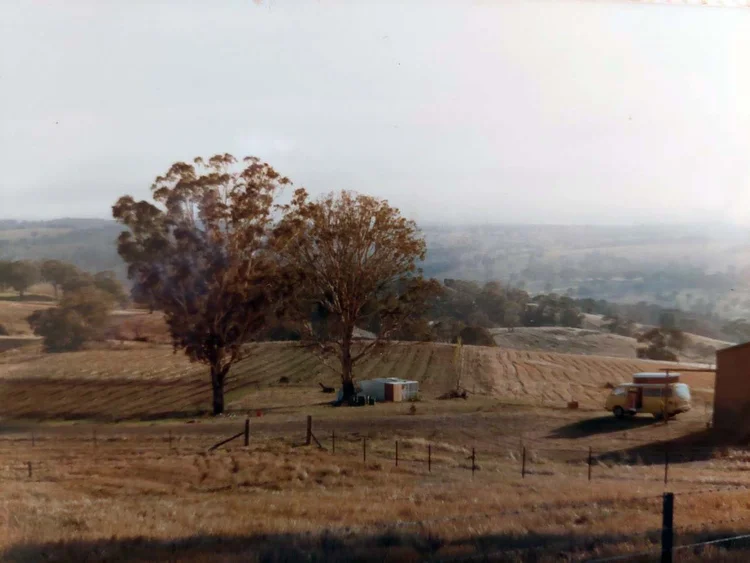
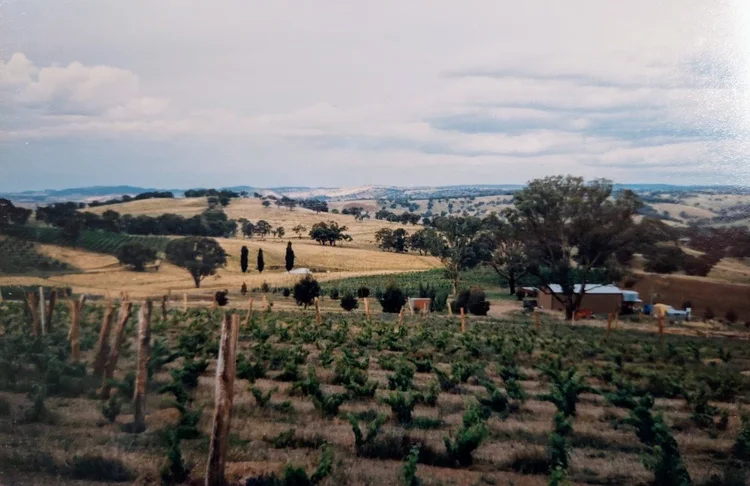
Looking North over our newly planted Cabernet vineyard. The lovely old yellow box tree on the right didn’t survive the after effects of the drought and the mastication of a thousand hungry sheep on its trunk. |
|
|
|
|
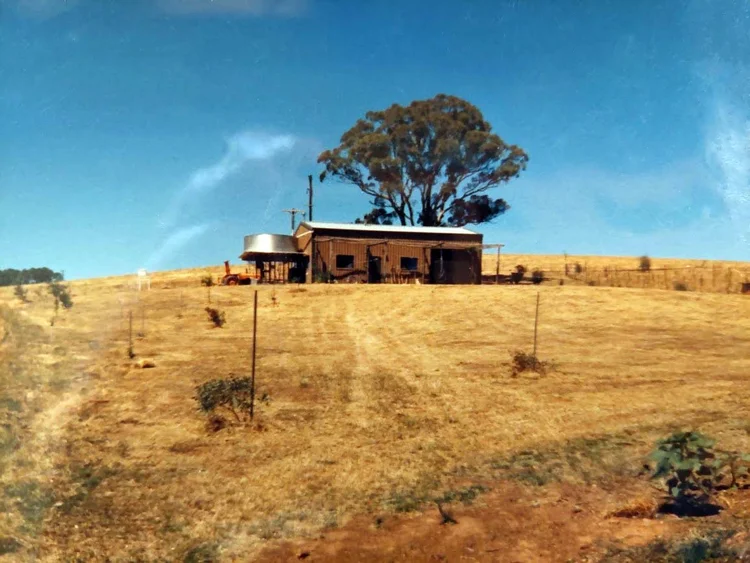
And so it begins … Our multi-function palace in 1986 with newly planted trees about to change the environment. The tiny white box to the left of the tank is our trusty BoM Stevenson’s Screen which was demolished by lightning strike in 2000. A portent of climate change? |
|
|
But there was undeniable energy and promise on the exhausted hillsides which spoke to us. There had been years of wine-making and viticultural study to help focus our search for a vineyard site which had the potential to grow cool climate grapes and when we first set foot on Bloodwood we both knew this was it.
|
|
|
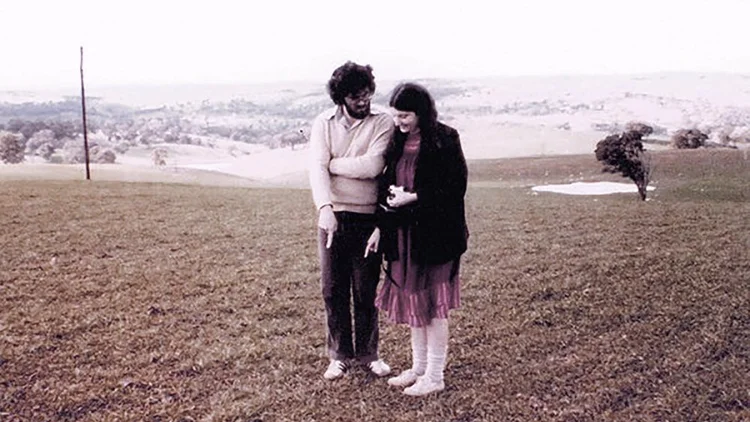
This’ll do. This is a picture taken by our dear friend Wayne Harris on our first day on our newly acquired land. Wayne is also responsible for the wonderful mural which warms our cellar door. |
|
|
Since 1983, we have planted and continued to plant thousands of trees, used only organic fungicides to control mildews and eschewed the use of insecticides and herbicides. We avoided the use of creosote on our hardwood trellis furniture and with the exception of our initial planting preparations have not cultivated one clod of Bloodwood soil for approaching 40 years. This has resulted in soil carbon levels that have grown from 0.3 organic carbon to around 6 after four decades of droughts, floods and ever changing climate challenges. We have achieved this through basically, deliberately, doing nothing to the soils of Bloodwood. We basically haven’t disturbed the soil. We selectively run livestock in the vineyard over winter and have continued to mulch the inter-row grasses and vine prunings back into the soil. Even our soft sulphur based mildew prevention sprays help soil deficiencies when they wash off the vines during rainfall.
|
|
|
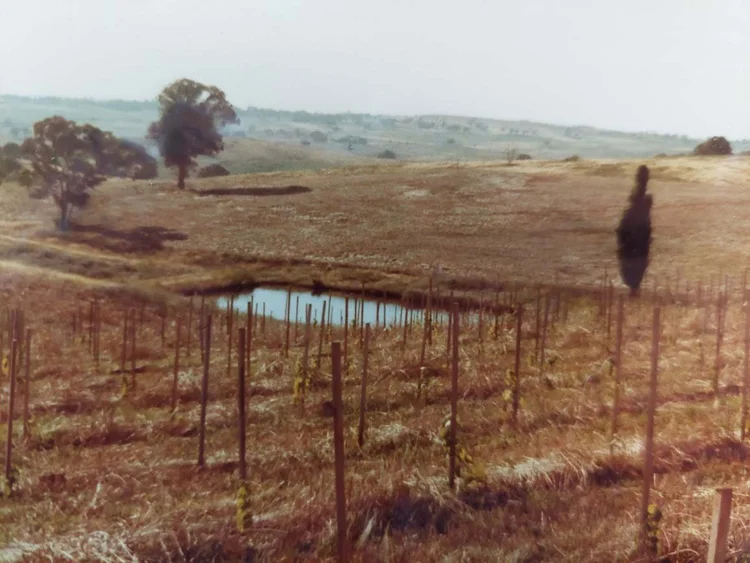
Blend Block with Orange in the background - 1983 We didn’t have the finance to install trellis infrastructure in our early days so we trained our young vines to individual stakes. Apparently that is becoming fashionable once again. |
|
|
|
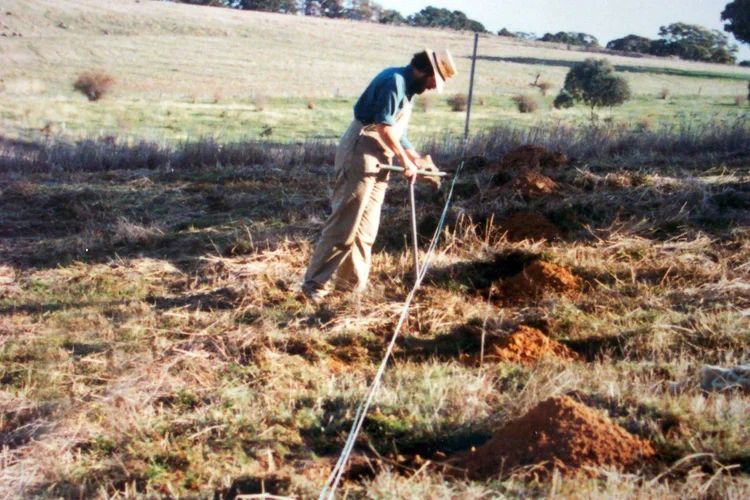
Preparing to plant stone and pome fruit trees 1983 as a diversionary crop for birds. Our orchard is now over 100 fruit and nut trees which progressively ripen from January to June. Tree planting has been a continual process over the last 40 years. |
|
|
|
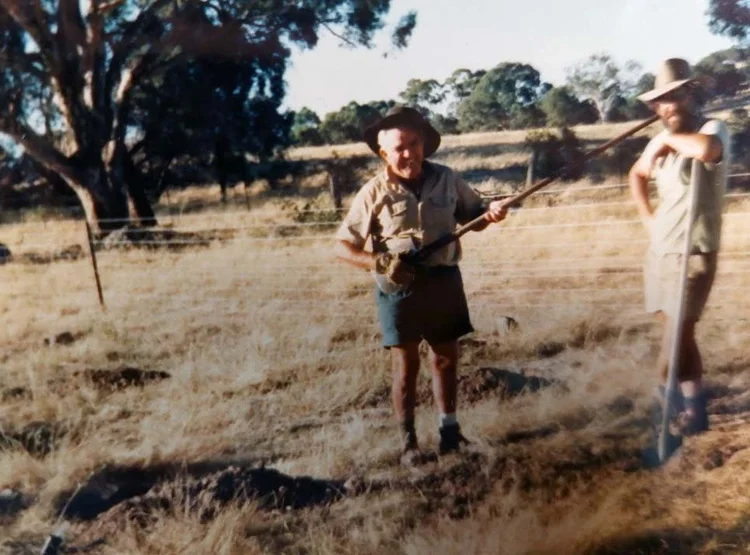
Dad playing shovel guitar with some bloke planting trees in1984. Because of the lack of shelter for livestock during cold and heat outbreaks, we began planting trees from the beginning. This particular shelter planting is called “the birdcage” for some reason or other. |
|
|
|
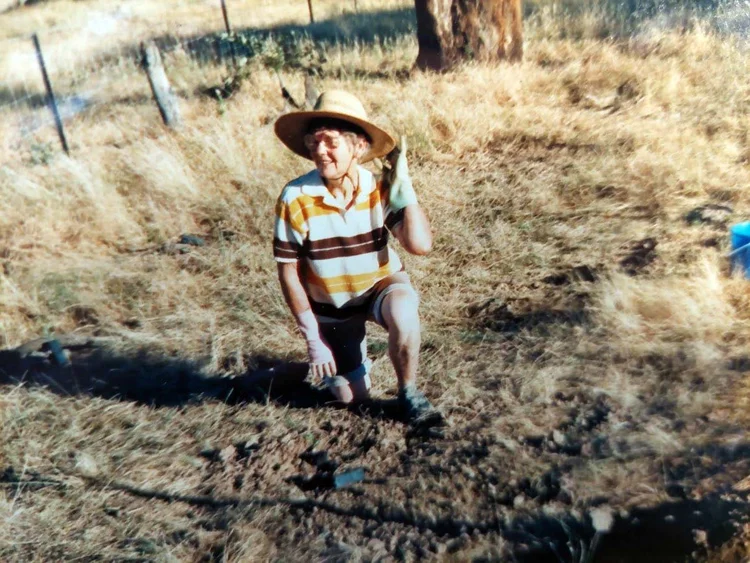
Mum planting trees in 1984. It was hard yakka but everybody pitched in including Fran. |
|
|
|
|
Trellis end posts the hard way. When we began there were very few vineyard supply firms in existence so we had to find our own end posts. These are local stringy bark posts newly barked and ready for erection in the Blend Block. No creosote, no post-hole digger and a lot of hard work. |
|
|
|
|
By 1985 the Riesling vines are underway. The posts haven’t been set properly yet. These were all done by hand. Some of the holes had to be blasted rather than dug with a shovel. |
|
|
|
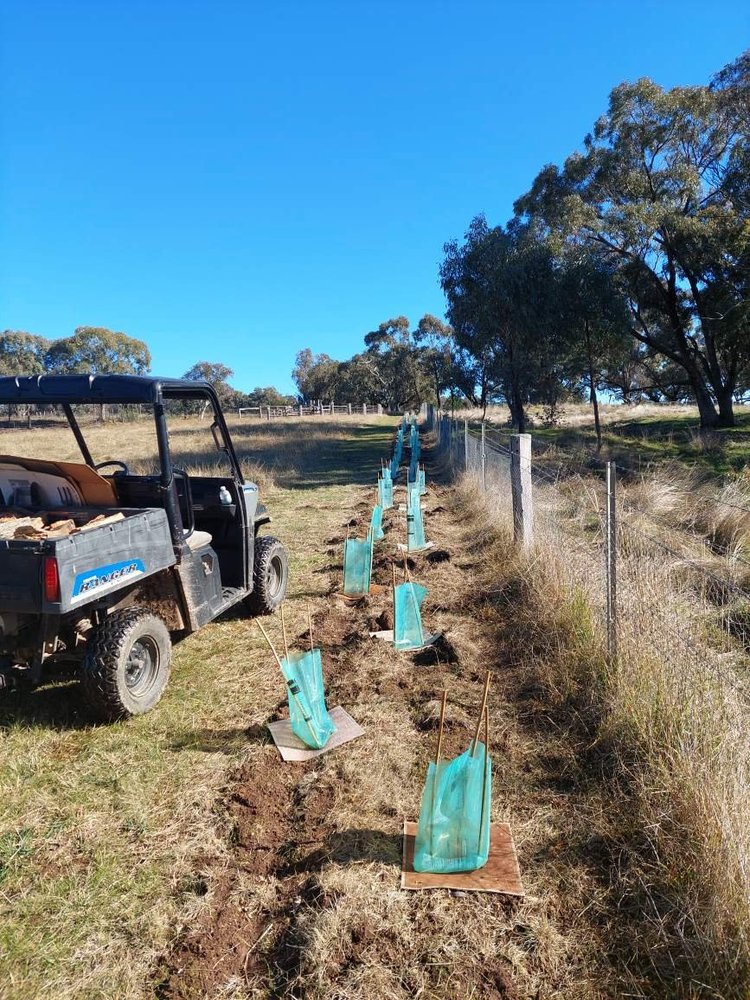
Tree planting has been a continual process over the last 40 years. This is the latest tree planting in the winter of 2021 in loving memory of our dear friend Dorothy Pearson. These are a mix of wattle and eucalyptus to provide wind protection and wildlife corridors. We hope Dot would have approved. |
|
|
————————————————— Sustaining the futureThere is a long way to go however over almost four decades, we have made a start.
|
|
|
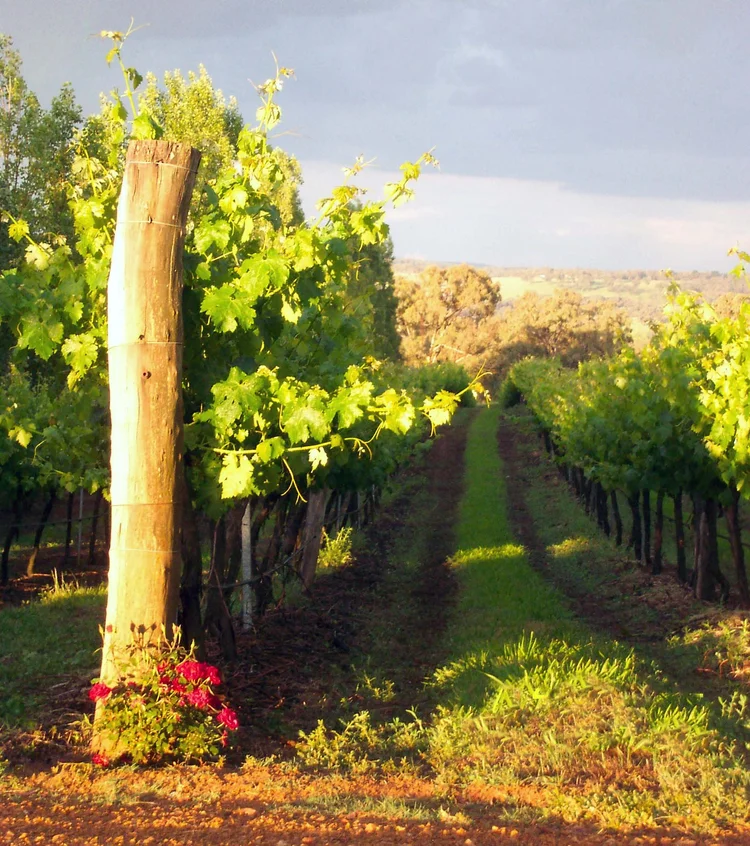
Flush spring growth in the Cabernet vineyard. The roses at the beginning of the row are subliminal advertising..red against wood. Bloodwood! |
|
|
|
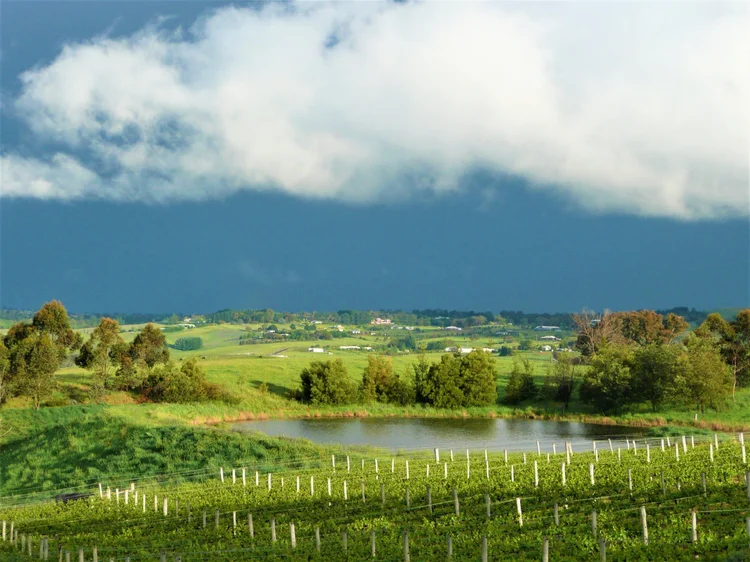
Schubert Chardonnay vineyard with Orange in the background. The Orange region is a “soft” grape growing environment. You have to be on top of mildew prevention. No more so than this Spring. |
|
|
|
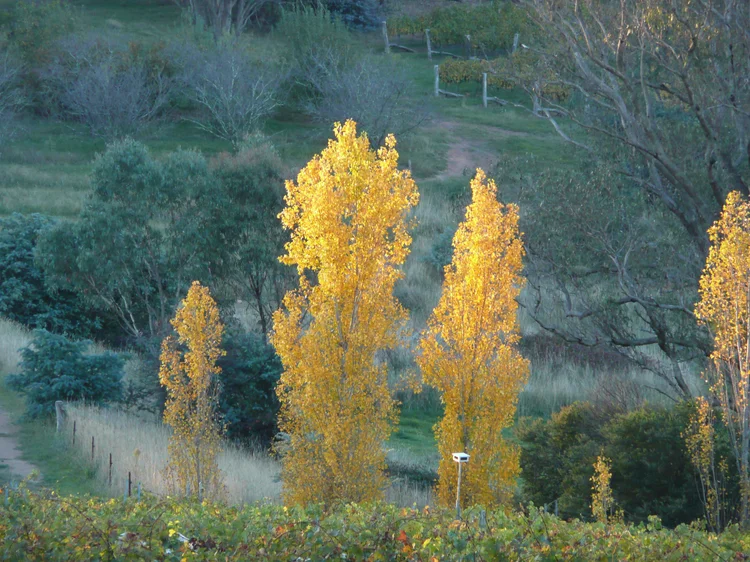
Poplars in Autumn. Cabernet is in the foreground and the orchard in the background. The box on the pole in front of the poplar is an electronic bird scaring device. Unfortunately it only seems to work on electronic birds. Real birds still eat the grapes. |
|
|
|
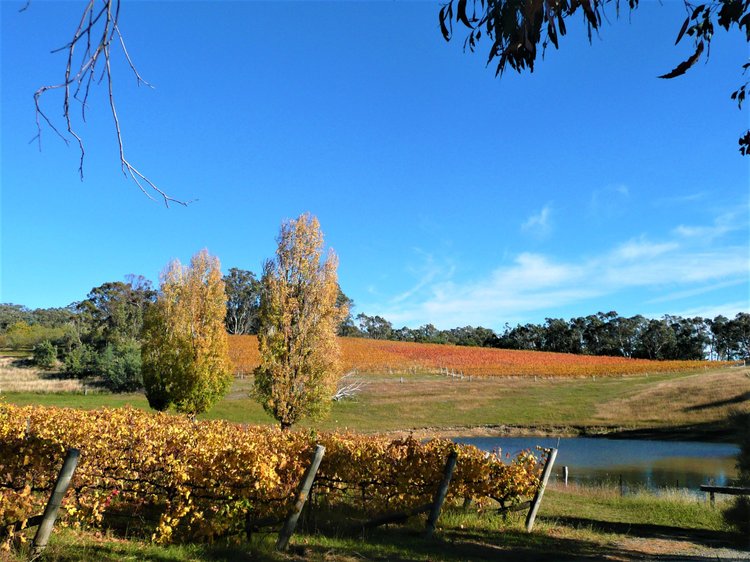
Autumn colours arrive. The different varieties of grapes can be seen in the changing colours of the leaves as winter approaches. In the background the dark red patch is Malbec and in the foreground is Shiraz. |
|
|
|
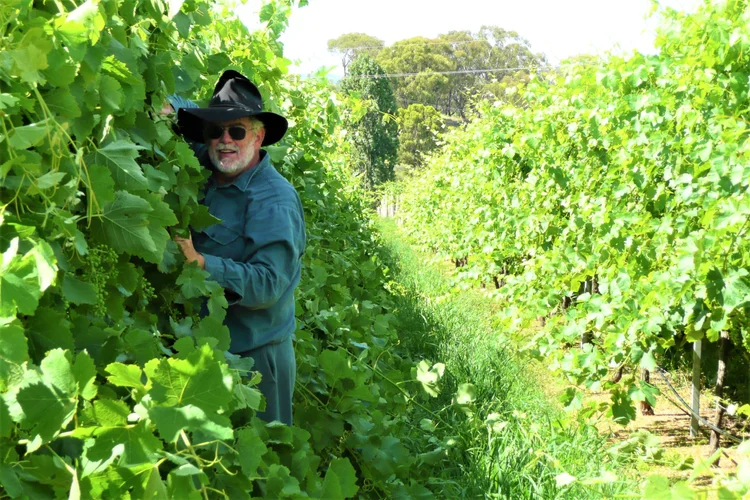
Jungle warfare in the Shiraz… splitting the Scott-Henry trellis to allow better sunlight interception, air flow and organic fungicide coverage. A lot of work but you can see the results in the bottle. |
|
|
————————————————— The Bloodwood wineryIn the winery, all our wines are produced as simply as possible. Hand-pruned, hand-picked and hand-made estate wines are bought into existence with care and patience. We allow them to mature slowly in barrel and bottle until such time as they are ready for you to enjoy. If you’ve been to Bloodwood you will realise that we produce more energy each year than we use. Our winery provides 1300KW of solar power annually and along with lead acid/carbon battery backup, we are largely free of the grid except for three phase refrigeration and pressing during vintage.
|
|
|
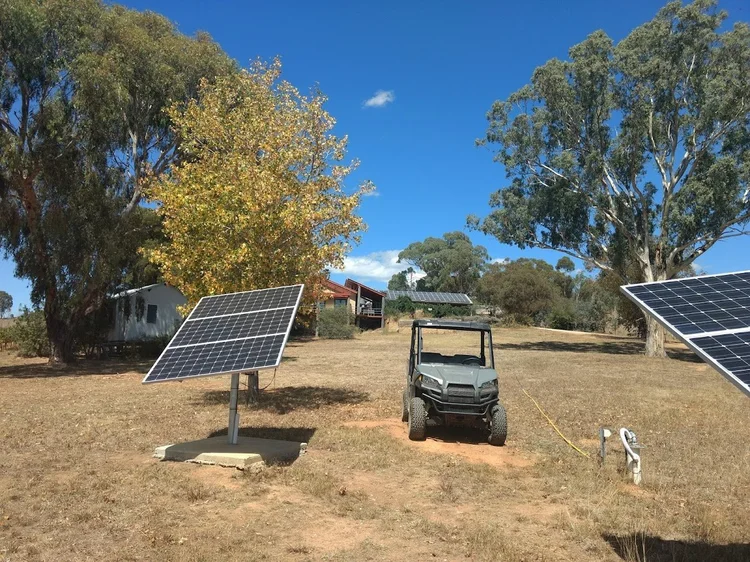
Solar bores, electric Polaris ATV and solar panels on the winery roof. The future is now. |
|
|
|
Battery backup for when the wind doesn’t blow and the sun doesn’t shine..and when the fossil fuel powered grid is demolished in weather events. The future is now. |
|
|
The vineyard, winery and cellar door is supported entirely using our own harvested rain water. Organic wastes left over from the winemaking process are returned to their vineyard of origin to help maintain the natural biota of the soil of each source block and when moisture is required for the vines, the vast majority of the energy required to move that irrigation water around is provided by solar energised pumps.
|
|
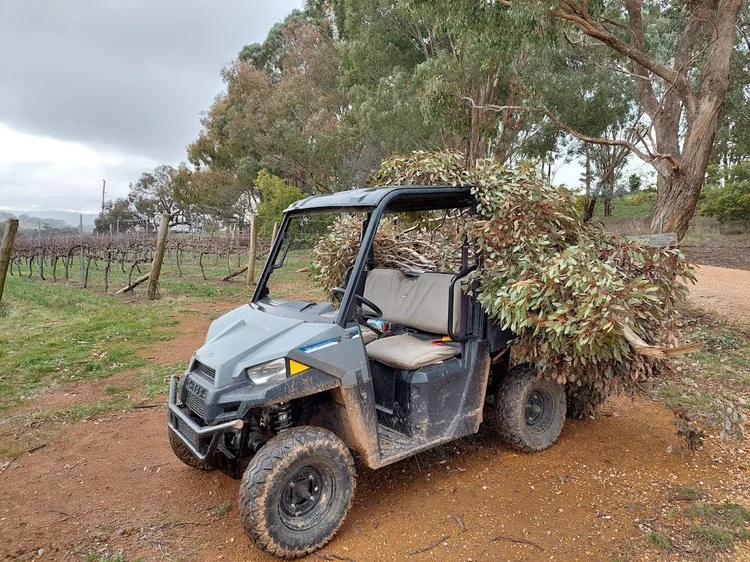
One of our electric powered All Terrain Vehicles being totally useless in the vineyard and ruining our weekends. This a pick-up of tree limbs demolished in this years snow falls. —————————————————
|
|
|
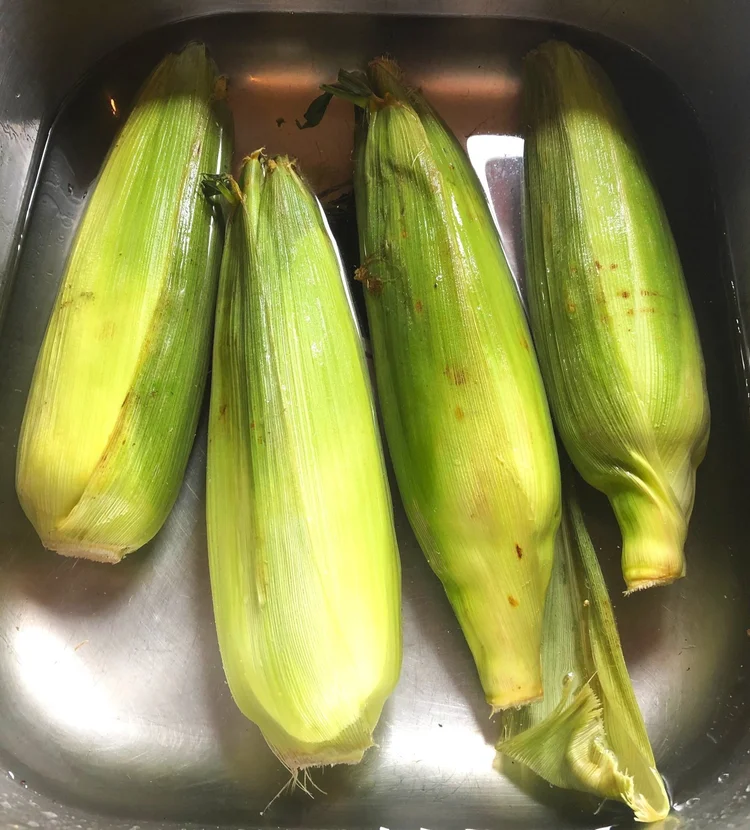
Having been a caterer, I am always on the lookout for a seasonal vegetable which can sustain a small course and work with one or more of our wines. |
|
|
————————————————— Presenting the Bloodwood A-maize-ing Cornucopia Offer3 2019 Riesling $96 (new release) 3 2018 Schubert $120 3 2017 Pinot Noir $126 (new release) 3 2021 Big Men In Tights $81 (new release) Packaging and freight $24 Total $447 A-maize-ing Offer $400 delivered unto your door. For full information on how these wines can enhance any meal, visit Rhonda’s Kitchen Season’s best from all at Bloodwood. Rhonda and Stephen and Mark and Biff.
|
|
|
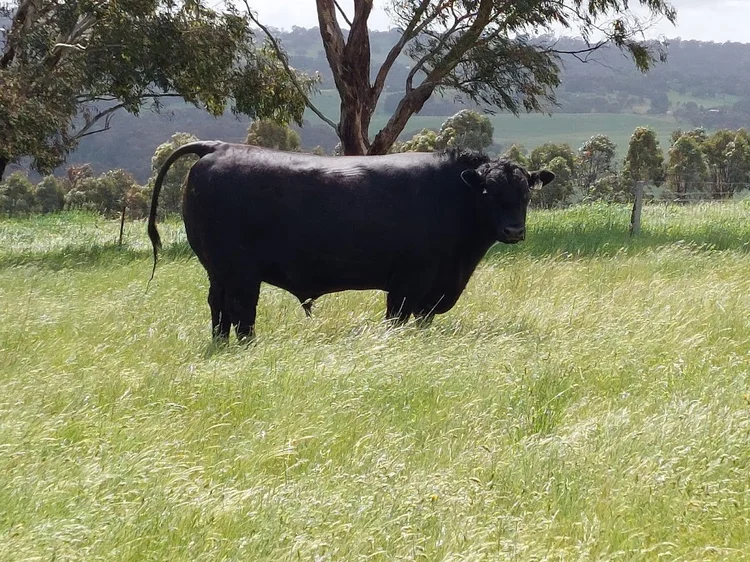
How are your bulls hanging Joe? This is Russell ready for action. |
|
Bomber JoeLate last week, I received a phone call from my mate "Bomber Joe", a strange fellow who lives just this side of the Victorian border near the village of Burrumbuttock. Burrumbuttock, for those of you geographically challenged is due east of Brocklesby and up the road from Howlong. (And you thought Howlong was a piece of string! It’s always been a town in the southern Riverina). Anyway, Joe is a tragic Bomber’s devotee; hence the name. He was named “Bomber” because of his obsession for his AFL team and “Joe” after “Bomber”. “Bomber Joe”. It’s a long story. Now when Joe rings, it's a pretty fair bet he wants to tell me something important. It's just that Joe, being the laconic type, is sometimes a bit hard to crank up in the conversation department, and it is as well to take things slowly with him for the first twenty minutes or so. It's not that he's a few vacuums short of an atmosphere or anything, it's just that he gets nervous on the telephone and extracting info from him is a delicate matter. My usual tack is to ask him how the bulls (he breeds bulls) are looking. This mostly works, given that the season is reasonable and after ten minutes or so on the relative disadvantage of extraordinary Estimated Birth Values in today's bull market, Joe says his farewells and intimates that he is about to hang up the phone. He intimates so, but he doesn't mean so. What follows is the traditional silence followed by my measured "Yes... Joe?" Says Joe "Well I liked that bit of a rev up youse got in the paper the other day" And so it goes..... What Joseph was referring to was an article by James Halliday in the Weekend Australian where he very generously reviewed three of our reds and gave an insightful appraisal of we here at Bloodwood.(Apparently I have a way with words and a wicked (at times esoteric)sense of humour.) Kabbalistic compliments aside, such a prominent article by Mr Halliday is a breakthrough for any winemaker, and is very good news for us. Now the Melbourne wine market is as parochial as its Sydney cousin thinks it is international. Indeed, from where we sit, the Melbourne marketplace is an extraordinarily stubborn beast to head-stall, and well and truly capable of displaying all its bovine angst to any outsider, particularly we north of the Murray types. Mind you, we've used all sorts of placatory measures to confuse the beast. Initially we spread the story that Orange is a little village in the highlands of Very Far North Eastern Victoria, and that we can give Melbourne a good run for its money in the misery stakes when it comes to weather. We even suggested that one of our natural advantages was that we are the closest cool-climate wine making district to Australia's most important domestic wine market. This of course is true, we are. That market in terms of volume is Sydney, but the phrase "most important" is just ambiguous enough to confuse our Melbournian friends. And is it working for us? Well, since The Weekend Australian article we have doubled our Melbourne sales. I’m even thinking of developing an interest in AFL. Thanks Joe, and "Up the Mighty Bombers" is all we can say! —————————————————
|
|
|
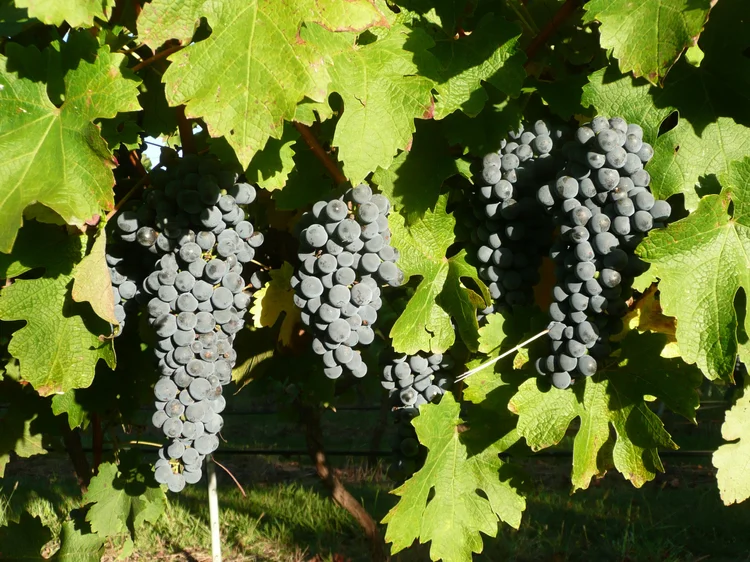
Cabernet grapes looking pretty good in the autumn sunshine. Some growers in Orange reckon you can’t grow Cabernet in Orange. The Bloodwood response...YOU can’t grow Cabernet in Orange. |
|
Grow a grape vinePlant a grapevine and it will be part of your life for a very long time. They are capable of producing delicious crops for many years. If you're one of the lucky people living in an older home, that neglected vine on the back verandah is likely to be as ancient, and in some respects, as precious as the house itself. You see, before the Riverland irrigation areas opened up early last century, the Central West, particularly areas around Orange and Molong, were famous for the flavour of their 'Black Muscat' table grapes. This fine fruit found an eager and lucrative metropolitan market late in the season. The few cases marketed now, are once again, keenly sought after. With the growth of the irrigation areas, and steadily freer trade and transport amongst the post-federation States, this speciality market was, over time, eroded. Even though at the turn of the 20th century there were as many local cherries as table grapes being sold into Sydney, nowadays, the table grape harvest is minuscule in comparison with wine grape developments. Why should this be so? My personal explanation is that this decline was the result of a number of factors, amongst which, shortage of labour during and after the Great War, and the relative profitability of other orcharding enterprises, are two. If I allowed myself less reason, I'd also add that the style of person consuming the end product had something to do with it. Eating grapes then, like cherries now, was a luxury past time, particularly if you belonged to the under classes of society. With transport as a major cost, and the highly perishable nature of the product, local table grapes would have commanded premium prices in metropolitan markets. After federation, the irrigation areas of South Australia had the potential to flood the market with quantities of table grapes at much lower prices. This they did, and table grapes became available to a wider and less discriminating audience. How many table grape consumers do you know who savour the flavour of each berry they taste? We've even become so lazy in our appreciation of the fine flavours of some of the seeded varieties that plant breeders are striving to produce grapes of larger dimensions and, preferably, without seeds. It may be of interest to realise that with very few exceptions, grapes bought on the retail and wholesale markets are all treated with hormone growth promotants during their growing cycle which elongate individual cells within each berry allowing the bunches to be larger and heavier. This also means they are less flavoursome than their natural antecedents but weigh more at the green grocer’s checkout. Compare the size of a sultana to one of those large green Thompson Seedless grapes you see at Woolies and it is difficult to realise that they are the same grape variety. And after all this you still have to consider the usual deluge of bunch rot protectant sprays and regular synthetic fungicides applied to those carefully presented plastic entombed fruit. Now there's little evidence that any of these chemicals are in any way dangerous to your health, but why not renovate the verandah vine and avoid the chance. Once you get a crop though, you'll have to learn to deal with seeds, (I feel sure most of you still have some of your own teeth) and the local birds may challenge your right to enjoy the fruit,(after all they've been living off them for most of the past century), but you'd be surprised at the flavours truly fresh fruit from an organically grown vine displays. —————————————————
|
|
|
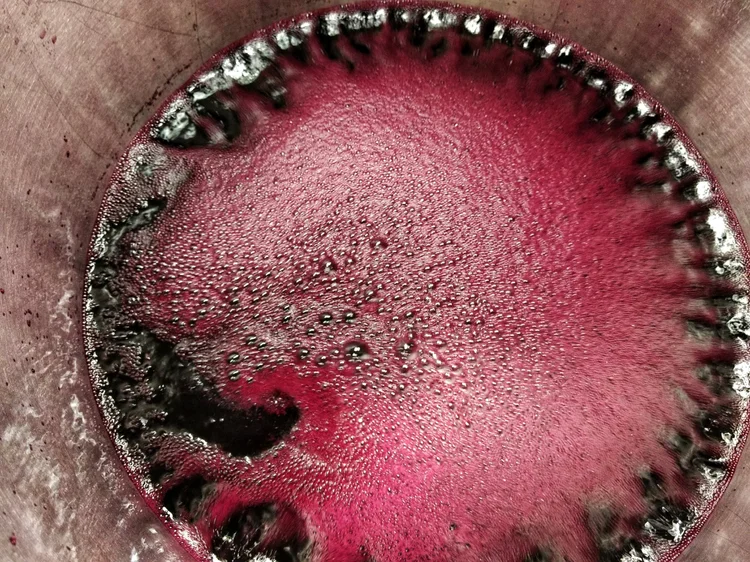
Malo well away, post pressing. This is the top of a 4,000 litre tank of Cabernet immediately after pressing. |
|
The Might of the 'Malo’Everybody has heard of fermentation. Every take-away you've ever eaten has reminded you of its bilious existence. It's that unpleasant business where the tucker you eat is broken down by micro-flora resident somewhere below last years hiatus hernia. This reaction releases quite a lot of heat, and copious amounts of gas as well as providing you with the energy needed to catch and cook your next meal. So to, with wine. Primary fermentation, or, as it's better known, alcoholic fermentation, is the process through which the accumulated sugar in ripe grapes is converted into alcohol and carbon dioxide. There is a direct relationship between the ripeness of the grape and the alcohol content of the wine. In a country like Australia, with its amazing sunshine, responsible for prodigious sugar levels in ripe fruit, this is cause for celebration. In fact, locally, it is illegal to add sugar to crushed grapes before fermentation. Not so in France. Although the amount of chaptalisation (sugar addition) is controlled, the practice is widespread. In Burgundy, there is some suggestion that this habit is responsible for the remarkable body and mouthfeel of some not so obscure, and not so lowly priced wines. In difficult vintages, Chaptalisation certainly plays a fine second fiddle in the many lesser wines of this area. However, while the French authorities turn an official blind eye to sugar addition when seasonally necessary, they myopically peer down their collective noses at our habit of acid adjustments to musts when analysis indicates this is advisable. Except in the very coolest areas of Australian viticulture like Orange, it is common practice to toss an ameliorating amount of tartaric acid into the must at the crusher to raise the acid level in the finished wine. While a very modest addition may be as low as 0.25 grams per litre of juice, much more is needed when grapes are overripe and are showing high pH levels. Adding acid helps produce better balance in the eventual wine, and a low pH (along with appropriate SO2 additions) helps protect the brew against microbiological accidents once primary fermentation is completed. There's an awful pong which creeps out of barrels when the malo is about. It's a strange sort of stale beer and mushroom smell which would almost be enough to make even a craft beer drinker pause between gulps. If the malolactic conversion isn’t complete before the chill of an Orange winter, it re-commences as things warm up about this time every year. It is a little recognised but useful secondary bacterial conversion. Many a home-bottler who has uncorked a robust sparkling burgundy, when what was put down could loosely be called 'claret', is unhappy witness to the might of the 'malo'! Grapes, particularly from cooler areas like Orange, have a naturally high malic acid content. This acid not only adds to the tartness of the finished wine, it is also an unstable acid, subject to attack and breakdown by malic 'eating' bacteria. If a wine is bottled containing malic acid, unless it is processed under completely sterile conditions, there is a good chance that malolactic bacteria or, even worse, acetobacter, will present the wine waiter or host with an indelicate choice. In fact, the pong can be so pungent, and the fizz so effervescent, that the description 'off' is entirely appropriate. Some fast talking or a handy sink is usually the order of the day. Where does it come from, this malolactic bacteria? Well, it appears. Like most things vinicultural, malolactic bacteria are a natural part of life. Like hares and mildew, bearded dragons and lightning fast brown snakes in the aviary, when there is a food source, they are about, whether you want them there or not. In older, established wine regions, the population of yeasts in the vineyard and winery make inoculation for both fermentation and malic conversion unnecessary. In newer regions like Orange, the practice is to seed ferments with selected strains of pure cultures to help this process. When is it done? The best time to encourage a clean malo in wines high in malic acid is to introduce a selected culture of malolactic bacteria at the peak of the ferment so that you can have some control over not only the strain of bacteria dominating the secondary ferment, but also the progress of its development. A check is kept on the course of the reaction until all of the malic acid is removed and the wine can safely be bottled. What usually happens to the wine is that the aroma, (which is primarily a reflection of the variety of fruit used) becomes less varietal and more vinous. That is, the wine takes on a more complex character on the nose and loses some of the overtly fruity characteristics that typify a new wine. It will also taste less acidic and more well balanced, all of which contributes to a better beverage for you and me to enjoy. And that's what good winemaking is all about.
|
|
|
|